Trying to Be Perfect from the Start Leads to Failure — Where Early-Stage Founders Always Fall
Why the pursuit of perfection slows down market validation, first-mover advantage, and growth at the same time.
Posted by: Gia Grace
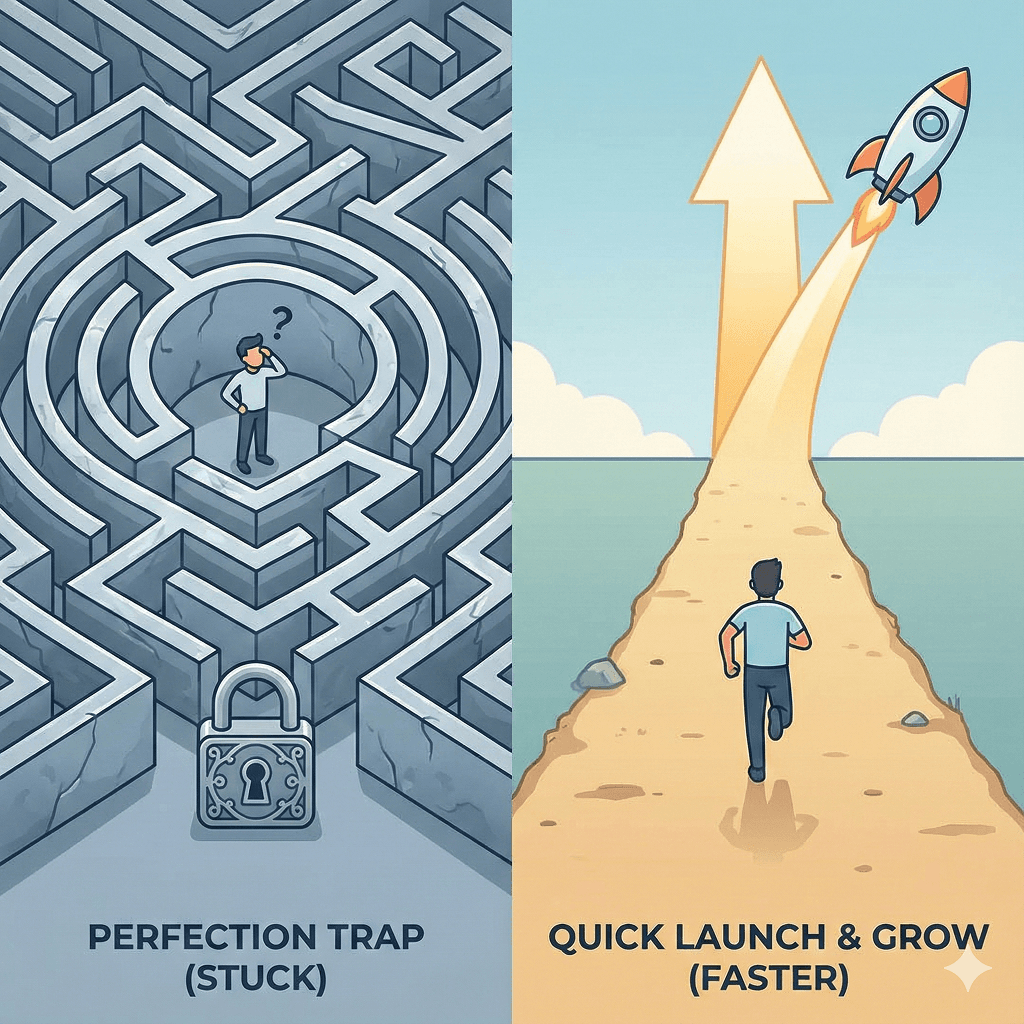
What “starting perfectly” really means for early-stage founders
When early-stage founders talk about perfection, they usually mean this:
the product feels feature-complete, the design looks polished, and internally it feels like there’s nothing left to fix.
The problem is that this sense of perfection is defined by internal standards, not by the market.
Perfection that has never been tested by real users is not certainty—it is merely a hypothesis.
Decision criteria: When does “perfection” become dangerous?
The criteria below are not meant to ask, “Should we polish this a bit more?”
They are meant to ask, “If we don’t stop chasing perfection now, does the risk of failure increase?”
If two or more of the following apply, perfection is no longer a safe choice:
- The product is being evaluated only through internal opinions, without real user feedback
- Launch timelines keep slipping, and there is no clear end date
- New features are added not to solve user problems, but to reduce internal anxiety
- Marketing or promotion cannot begin because the product is “not ready yet”
- Competing services already exist or are likely to appear soon
At this stage, perfection is no longer about quality—it becomes a decision to delay launch.
Failure pattern: The typical path created by perfectionism
Many teams repeat the same cycle.
They add features, refine design, and conduct internal reviews—again and again.
But nothing reaches the market.
There are no users, no data, and no feedback.
The longer this continues, the more the product looks “better” internally, while externally it remains a service that does not exist.
Market perspective: Perfection means giving up first-mover advantage
The market does not wait for perfect products.
The service that appears first defines the initial user experience and sets the baseline.
A quickly released MVP may be incomplete, but it allows teams to observe real friction, fix it through updates, and secure an early foothold.
While waiting for perfection, all of these opportunities are handed to competitors.
Growth perspective: Updates and marketing only begin after launch
One critical fact many founders overlook is that marketing and customer acquisition can only begin after launch.
A product must exist before user reactions can become content, and before improvement stories can be shared as momentum.
While waiting for perfection, marketing stalls and users never arrive.
As a result, growth is postponed indefinitely.
What early-stage teams really need is not completeness, but iteration speed
The most important question for early-stage founders is not,
“Is this perfect enough?”
It is: “How fast can we learn and improve through this?”
Launching quickly, identifying user friction, fixing it through updates, and gradually improving market signals — this is the most realistic growth strategy in the early stage.
An imperfect start creates a stronger beginning
Starting in an imperfect state makes it easier to pivot and respond flexibly to user needs.
This is exactly what Incomplete Vibe Coding represents.
Instead of deciding everything upfront, the product evolves together with the market.
A well-started structure determines how fast improvement can happen afterward.
This is why “Well begun is half done” matters most at the earliest stage.
Summary
At the early startup stage, perfection is more likely to cause failure than success.
Waiting for perfection delays market entry, user feedback, updates, marketing, and customer acquisition.
Releasing quickly and improving through iteration is the most realistic strategy for early-stage businesses.