The Difference Between “An App You Can Build” and “An App People Keep Using”
Today, building an app is easy. But apps people continue to use still have very clear reasons.
Posted by: Ryan Ross
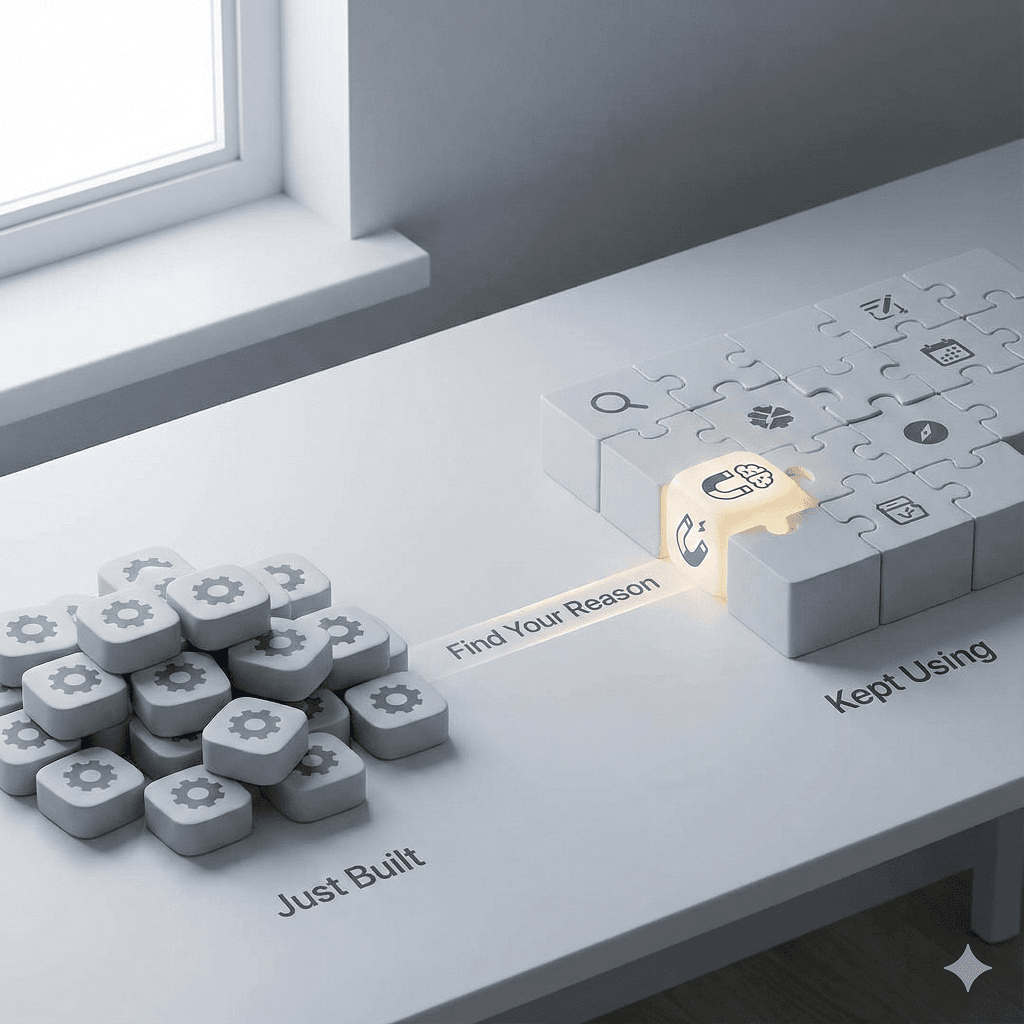
Building apps has become too easy
Vibe coding, auto-generation tools, no-code and low-code platforms, outsourced development—today, “building an app” is no longer a major barrier.
Almost anyone can quickly create an app where buttons work, screens transition, and features function as expected.
That’s why so many apps get launched.
But reality after launch looks different.
Many apps are opened a few times early on and then quietly abandoned.
There’s nothing technically wrong, yet users leave.
The problem isn’t that the app was poorly built—it’s that there’s not a strong enough reason to keep using it.
A Shift in Thinking: “Usable apps” and “apps people keep using” are not the same
Many people assume that if an app works well and is reasonably usable, that should be enough.
Basic usability and stability are certainly necessary—but by now, most apps already meet that baseline.
Users no longer ask, “Can I use this app?”
They ask, “Why should I use this app?”
The market is full of apps with similar features, and users have little reason to relearn workflows unless there’s a clear benefit.
Apps that people continue to use must clearly communicate why they should be chosen over alternatives—before features or design even come into play.
Decision Criteria: How differentiation that users accept is actually created
Differentiation in apps people keep using is never vague.
First, even existing features must be restructured to fit the app’s category.
Scheduling features exist everywhere, but in a healthcare app they focus on tracking change, while in a work app they focus on context and continuity.
The feature may be the same, but the value users feel is completely different.
Second, if an app has a truly new feature, it must be immediately visible. Users should understand within seconds, “This works in a way I haven’t seen before.” Hidden features don’t create differentiation.
Third, even without special features, the app must deliver a consistent experience aligned with its concept and purpose.
If colors, typography, screen structure, and feature placement don’t point in the same direction, the app feels like a collection of features.
Users then don’t know what the app is really for.
Why users leave immediately when there’s no differentiation
Users are not generous when evaluating apps.
If the question “How is this different from what I already use?” doesn’t get an immediate answer, there’s no reason to stay.
When features overlap, flows feel familiar, and nothing leaves a lasting impression, users won’t form a new habit.
An app without differentiation isn’t a bad app—it’s simply an app that doesn’t get chosen.
In those cases, users don’t complain.
They just quietly delete it.
Many apps disappear not because of poor quality, but because they lack a clear reason to exist.
Conclusion: Apps people keep using are designed around reasons—not features
The technical barrier to building apps has nearly disappeared. But apps that people continue to use remain rare.
The difference isn’t how well an app is built, but how clearly it answers why it should be used.
It could be a new feature, a restructured experience within an existing category, or a stable, category-appropriate flow.
What matters is whether users have a reason to choose this app over others.
Apps that last aren’t created by accident—they’re designed from the start with comparison and choice in mind.
Summary
Apps are easy to build today, but apps people keep using are different.
Users stay only when there’s a clear reason to choose one app over another.
That reason may be a new feature, a restructured category experience, or a consistent concept.
An app’s survival depends not on features, but on its reason for being chosen.