Should You Build the App Yourself or Delegate It? — A Founder’s Choice About Time and Focus
The difference in how an app is built is not a technical issue—it’s a question of where you spend your energy.
Posted by: Bart Anderson
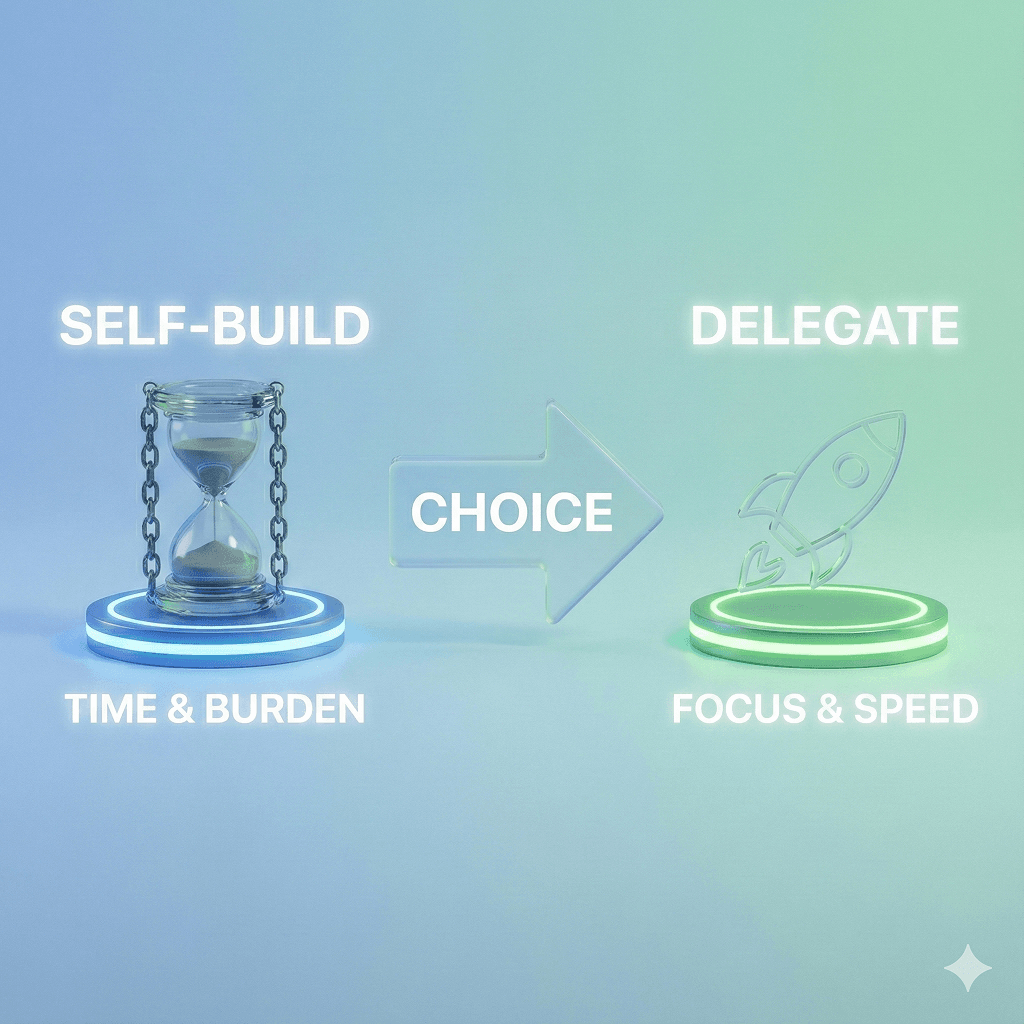
What does “building it yourself” actually mean?
When an early-stage founder says they will build the app themselves, it does not simply mean writing code.
It means choosing a tech stack, understanding server architecture, thinking through design flows, fixing bugs, and taking responsibility for updates and release.
Each of these steps involves a series of decisions, and making those decisions requires far more background knowledge and time than most founders initially expect.
Reality: The problems you inevitably face when building it yourself
Once founders decide to build the app on their own, they tend to get stuck at similar points:
- It’s hard to decide what to build first
- Features exist, but the UX flow feels awkward
- There’s no confidence that the design fits the business
- When bugs occur, it’s difficult to find the root cause
- As changes and additions accumulate, the overall structure starts to wobble
In this process, the founder naturally ends up taking on the roles of product manager, developer, designer, and QA all at once. The problem is that none of this time is actually spent on the business itself.
A shift in perspective: Does delegating mean giving up control?
Many founders worry that delegating means losing control over direction.
But what really matters is not who builds, but who decides and who gets to focus.
Delegating well is not about giving up control—it’s about letting go of implementation burden so you can concentrate on decision-making.
Business perspective: A founder’s scarcest resource is focus
At the early stage, a founder’s time is limited.
You need to understand the market, analyze user reactions, refine the business model, and prepare for investment or marketing.
When energy is consumed by implementation details, critical business decisions are delayed.
So what actually changes when you delegate to AppBuildChat?
Delegating to AppBuildChat is not simply outsourcing development.
It is closer to having a partner who handles validation and release as a single continuous flow.
- You can build quickly and validate in the market
- Unnecessary features are removed, necessary ones added immediately
- Features and design are adjusted based on user feedback
- The entire process, all the way to release, is handled in one flow
The founder only needs to make decisions such as:
“I want to add this,” “This flow feels uncomfortable,” or “I want to launch.”
Implementation, iteration, validation, and release are handled by AppBuildChat.
What matters more than building skill is a fast validation structure
For early-stage founders, the key question is not “Can I build this?” but “How quickly can I verify whether this idea works in the market?”
Building it yourself allows learning—but it takes time.
Delegating creates speed, and that time can be reinvested into the business.
Summary
Building an app yourself requires many decisions and continuous learning.
Delegating reduces implementation burden and allows founders to focus on business judgment and market validation.
AppBuildChat supports early-stage founders by handling rapid validation, feature and design iteration, and release in a single streamlined process.